
Pressured from outside and inside, Iranian society cannot experience its emancipation
Interview about the Iranian protests in 2026 during the days of their bloody suppression

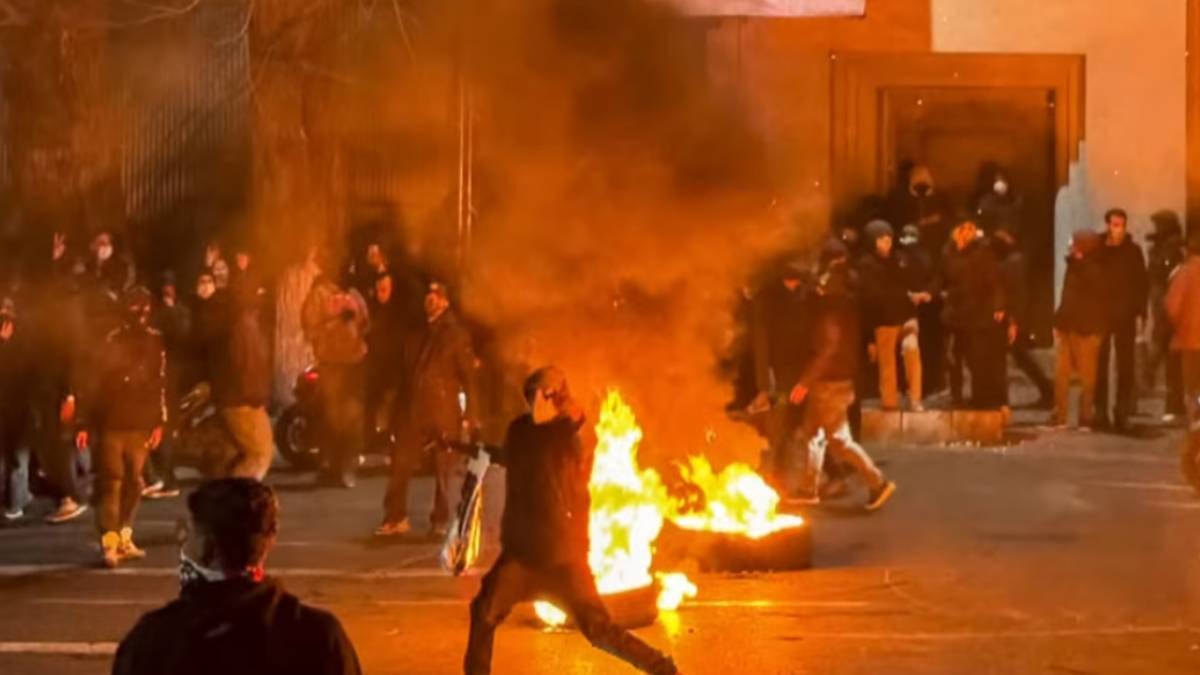
Ivaylo Stefanov, Hristo Botev program, Bulgarian National Radio, January 16, 2026
Ivaylo Stefanov: Good evening to Vladimir Mitev, our colleague from Radio Bulgaria, who is primarily from the Romanian editorial office, but is also an expert on Iran, having studied Iranian studies and being the founder and author of the blog “The Persian Bridge of Friendship.” The topic, of course, is the new protests in Iran, which I would even describe as uprisings—I don’t know if you agree with me.
Vladimir Mitev: Yes, we are seeing something quite large-scale in Iran.
Ivaylo Stefanov: The protests began shortly before New Year’s Eve, on December 27–28, and are still ongoing; they are massive. As we know, this time they began for social and, more specifically, socio-economic reasons. Perhaps a little more on that – what is your view on how they began?
Vladimir Mitev: Something remarkable and specific about these protests is that their beginning was linked to the discontent of a group of people called bazaaris. These are, let’s say, small businesses or traders from the bazaars in Iran, who are generally supporters of the Revolution. And in this case, the fact that they closed their shops and began to express some discontent, in my opinion, shows that the country’s economic problems have gone too far.
I should remind you that at the end of September, the full sanctions that existed against Iran before 2015, before the nuclear agreement, were reinstated. On the other hand, for quite some time now, there has been a gradual abolition of a specific exchange rate, which to some extent allowed the state to subsidise the purchase of certain products at lower prices by traders. This was somewhat of a social measure or even a measure that benefited business, and the fact that this subsidized exchange rate has now been completely abolished also contributes to this situation, I think.
Ivaylo Stefanov: Nevertheless, the protests then turned into demands for a change of power, of course, just like the previous protests. What do you think are the similarities and differences with the protests of 2022 or even earlier, from 2019, 2009, and so on?
Vladimir Mitev: I think one of the similarities with the protests of 2022, which were linked to the “Woman, Life, Freedom” movement, is that in these protests we also see cases of women burning their veils, their hijabs.
This is a demand that emerged in 2022 and reflected a cultural change in Iran—the fact that many people in Iran are secular-minded, the fact that women are quite educated and want to control their own bodies, not have a certain dress code imposed on them, or define for themselves how they comply with this dress code.
These things exist to some extent here as well, but I think that in this case it is much more significant that there is discontent among different groups in society. I defined it with one expression – “intersectional,” although it sounds quite heavy, but the idea is that both workers and traders, people from the business sector – the various groups in Iran are feeling the sanctions and economic difficulties en masse, and life is clearly becoming unbearable.
Perhaps there is something similar with the protests of 2009. For those of 2019, which were provoked by the rise in gasoline prices, I think it is clear that there is some overlap in that they were created by economic demands and problems. And in 2009, a process began that significantly strengthened the Revolutionary Guard’s influence in Iranian society. We know that there were elections at that time, which were accused of not being entirely fair, and then Mahmoud Ahmadinejad came to the fore.
Ultimately, we see the mass discontent then and now, insofar as there are attacks on mosques and there is clearly a certain orientation against Islam, against the Islamist tendency in the country. So these things are clearly smoldering in some way—the various rifts in Iranian society are smoldering and periodically flare up.
And in this case, in my opinion, it is the economic difficulties that are bringing many people out onto the streets with a desire for real change. And if you don’t challenge the authorities, if you don’t challenge the government, perhaps it simply won’t pay you the attention you need. And that is how I explain to myself, at least to some extent, why all the protests in Iran are periodically linked to demands such as “Death to the dictator” – they always turn against the country’s leadership; simply because if no challenge is made to that leadership, it is as if the people have done nothing.
Ivaylo Stefanov: Well, yes, because too many and too different groups are against the Islamic dictatorship. Incidentally, this time the protests did not start in the northwestern part of Iran, in the Kurdish areas, but in Tehran and the southern cities. I know that in the beginning there were also protests in Shiraz, Mashhad, and other cities, but they spread everywhere. Do you think the fact that different groups are protesting would divide the protests, or would it eliminate the differences between the various groups protesting and unite them against the government as a whole?
Vladimir Mitev: I think that at the beginning of these protests, this was perhaps something positive – that different social groups were finding some common direction in their behavior, in their political action. We see that at the beginning, the representatives of the government, even President Peseshkian, seemed to me to be quite well-intentioned – they said that the protesters’ demands really needed to be heard, they found some logic, some meaning in them. However, as usually happens, everything is interpreted through some kind of geopolitical prism or along the lines of whether you are with the government or against it. In other words, we are seeing a radicalization over time, and ultimately what we have now is a rather sad situation in which hundreds and even thousands of people have been killed.
Ivaylo Stefanov: Yes, unfortunately, the numbers have become very high, but there is no way of knowing the exact number of people killed, as the internet has also been shut down there in recent days.
Vladimir Mitev: I have come across information that around 100 law enforcement officers have been killed – this is, of course, a claim made by the official media; it is also difficult to ascertain whether this is actually the case. What I want to say is that Iran needs to go through certain processes in its social development, and I associate the fact that a reformist president was elected with precisely such an attitude and awareness, including among the elites, that certain processes – such as reform, liberalization, greater respect for people’s dignity or their rights – must happen. But we see periodically how, the moment something starts to happen, even a slight opening, a slight movement in a more progressive direction, there is immediately an interpretation that this is being used by Iran’s enemies.
And here it seems to me that Israel, with its intelligence, and perhaps Donald Trump, intervened in a way that did not do the protesters any favors. They literally said, “Go out and protest.” There was such a statement by Mossad at the end of last year, if I’m not mistaken. Donald Trump also shows some willingness to intervene, to defend the protesters, but in my opinion this is not necessarily always helpful, because it gives the authorities in Iran arguments to view the protesters exclusively through the prism of security. That is, to view them as subversive or driven by external forces, namely the government’s enemies. The strong pressure on Iran, which has been exerted for years by external forces, prevents the country from going through certain processes normally, as I said, which it simply has to go through in order for society to develop further. This hegemony, which is being exerted on Iran and which Iran as a government is exerting on its citizens, is preventing the relevant processes from taking place. This is also the source of the discontent, which is quite significant.
Everything that happens in Iran has a very strong emotional intensity – usually negative, especially now with these protests and casualties. Otherwise, when traveling in normal times, people who have traveled to Iran say that Iranians are very friendly, very well-meaning, hospitable – there is intensity in the good as well. But things are very emotionally intense, and that is also why the processes that need to unfold cannot unfold. Whenever this social evolution begins to be viewed through the prism of security, it means that it will be blocked in the next moment. And that is why there must be some way for Iranian society itself – and for us too – to view it as a society that is not just a function of external forces; it is not just a society where people are only against the government, or only pro or anti Trump and so on, or only pro and anti the heir to the Shah.
This is a society that has its own life, and perhaps this is where we, the journalists who report on Iran, should start – by trying to look more often at the contradictions, at internal Iranian life, at the fact that there are different movements even in this highly controlled public life. There are different labor movements, there are feminist movements, and these movements are enduring. But as I said, the moment they start to raise their heads a little and control weakens so that the relevant changes can be implemented, everything is immediately seen as some kind of weakness of the regime; and accusations begin, or some people gloat that now “the ayatollahs’ regime” will collapse, and everything is interpreted again through this framework of security, which, as I said, does not help.
Ivaylo Stefanov: Here it is perhaps worth mentioning that, unlike many Venezuelans, who were opposed to Maduro before his overthrow and abduction by Trump, the vast majority of Iranian oppositionists—at least I have not heard of any who are “for” it—are all against bombing by the US and Israel, even though they are against the regime.
Vladimir Mitev: I think we had the opportunity to talk about this in a previous program, when it was the 12-day war; I interviewed Iranians from the diaspora who in no way sympathise with the current regime in Iran, and yet they were firmly opposed to the idea that bombing could bring democracy and positive change to Iran. Here, I should also mention that the expectations of the Iranians I talk to—perhaps more the left-wing Iranians, of course—are that if there is external intervention, if there are air strikes or any kind of external intervention at this point, it will only strengthen the regime even more. We see that the security forces are not divided, there are no conflicts within them – they are rather uniting at the moment against the challenge posed by the protesters. There is a possibility that the regime will tighten its grip even further, which means persecution at the slightest suspicion of any collaboration with the enemy. In other words, there will be many death sentences handed down by the courts, and once again, the wounds that periodically open up in Iranian society will not heal.
The other option is that some kind of external intervention, bombing, or attack on Iran could intensify the contradictions within Iranian society, but this is also not seen by my acquaintances as a positive option, because then the tension, which is already at very high levels, will continue to be so; the confrontation will be at a high level and Iran will again suffer many casualties. In other words, if I understand correctly, the ideal option for Iran is a benevolent one, with dialogue and understanding between the different groups, in order to bring about a certain change in society. And the fact that tension is periodically introduced into the system, that everything is a matter of life and death, and that the accusations are very radical in both directions, prevents these processes from happening.
Ivaylo Stefanov: I know it’s very difficult to make predictions, but do you think that something will really change in Iran? Do you think that the government is really shaken this time? Here we should also remember that Iran, however homogeneous it may seem, is not really so – apart from the different social groups, politically we have a very large Kurdish minority, who have already come out with slogans comparing the dictatorship to fascism. We have Azeris, we have Baluchis, we have quite a few centrifugal forces in this society, and many people also talk about the supporters of the Shah, while others say that this is Israeli propaganda. Do you think that all these groups will still manage to bring about some kind of change, or will they be crushed again?
Vladimir Mitev: I think the Iranian state is much more solid; at least we see how many protests there have been so far and it always somehow resists. Obviously, there are certain structures in society, there are mechanisms, etc., that allow this state to absorb these blows that come from society and even from outside. So somehow it seems to me that it is premature to predict with every protest, with every discontent, that this is the end of this state. It has been showing for 47 years that it is standing. No matter how much tension there is, no matter how many sanctions there are, no matter how difficult everything that is happening or not happening is, it somehow stands.
You mentioned that there are different social groups, different minorities, different interests in different directions; perhaps it is important that, to some extent, as far as I know, there is an awareness in Iran that the region is undergoing a disintegration of countries that previously existed – i.e., Iraq, for example, is much more politically fragmented than it was during Saddam Hussein’s time; There is also Syria, there are Kurdish areas, there are different areas in different countries...
Ivaylo Stefanov: ...which, by the way, are currently in conflict with the new government in Damascus.
Vladimir Mitev: In other words, there is a process that is usually called “The Greater Middle East” – a vision of the Republicans in the US, and in Iran, in my opinion, there are certain concerns that the state is preparing for something like this: to be broken up into small regions. It seems to me that, after all, Iranians are united above all by their culture, their language, their society, and their country. Not everything is just about power relations, not everything is just “for” or “against” the state. It is clearly believed that a more serious upheaval could lead to more negative consequences. This is how I explain why there are also people who protested this month in support of the government.
Personally, I would not make a prediction, I just think that whatever happens, we must bear in mind that Iran is ruled by Iranians. No matter how much it is interpreted that external forces are involved—some with Russia, others with the US, others with the UK, etc.—I think that Iran is still an Iranian state for Iranians, and whatever happens will happen through the people who live there. These attempts to impose or throw in some figures from outside, or to interpret what is happening in Iranian society in our own way from outside – I think it is clear that these attempts have limitations in their validity.
Ivaylo Stefanov: Incidentally, let us mention that slogans such as “Neither Gaza nor Lebanon, our hearts are in Iran” are being chanted at the protests. In other words, a rejection of the Iranian state’s policy of supporting the oppressed in Gaza and Lebanon, who are victims of Israeli aggression.
Vladimir Mitev: Yes, here I must say that Iran should not be reduced solely to the Islamist tendency—there are people who are an intelligent elite and realize that these proxies that Iran has supported in recent years cost a lot of resources. Moreover, they create tension between Iran and its potential Western partners. Ultimately, Iran does not gain much from this tension – in the sense that it may maintain a certain course, but economically it is greatly weakened. It has significant resources, and there is a realization, as I said, among the people I am talking about—who are more reform-minded—that if Iran integrates into the global economy, its resources will bring it more returns.
In addition, the country has an elite that is very serious, very educated people; Iranians simply have a predisposition to study, and to study the exact sciences, the serious sciences. And this Iranian elite, as well as these Iranian resources, both human and natural, should take the country to a whole new level, as long as it somehow overcomes the sanctions that have been imposed and restores trust with its international partners. And in this sense, I believe these demands should be interpreted in this way. There is a realization that Iran’s interest is not only in having an “axis of resistance,” but also in being part of the world. These two understandings coexist in one country, but obviously, when the sanctions are too strong and the people pay the economic price for Iranian independence in foreign policy, there is a realization that perhaps this is not the best option for everyone as a whole.
Ivaylo Stefanov: Thank you to Vladimir Mitev, author of “The Persian Bridge of Friendship” and our colleague from Radio Bulgaria. We will continue to follow the situation in Iran and hope that there will not be many more casualties.